


Blog
What you need to know about physiotherapy and podiatry.

 Our Locations
 Physio&SoleClinic
 Physiotherapy, Podiatry
  April 28 2026

Written by
Senior Partner & Principal Musculoskeletal Physiotherapist at Women And Children Centre and Physio & Sole Clinic
A musculoskeletal physiotherapist with a strong focus on scoliosis care, Farha brings experience from KK Women’s and Children’s Hospital, where she worked across diverse conditions and age groups. She is a pioneer in scoliosis-specific exercise therapy, advocating active conservative treatment beyond traditional bracing. Trained by international scoliosis specialists in the United States and Netherlands, Farha combines patient education with hands-on techniques to deliver holistic, individualised care, helping patients of all ages improve posture, reduce pain, and move with confidence.
Not all toddlers start walking at the same age, but when your child isn’t walking by 18 months, it’s often a cause for concern. Is it just a delay, or something more? This guide breaks down what late walking really means, when to take a closer look, and how a paediatric gait assessment can give you clear answers. Whether it’s reassurance or early support, knowing what’s happening can make all the difference.
If your toddler is nearing 18 months and still not walking, you might be wondering:
“Are they just taking longer?”
“Should I wait?”
“Is something wrong?”
The truth is, children develop at their own pace.
But in some cases, delayed walking can be linked to issues with balance, strength, or foot development.
Understanding the difference is what matters.

A toddler is generally considered a late walker if they:
Milestone breakdown (12–18 months)
Not all late walkers have a problem.
But when progress stalls or movement looks unusual, it’s worth taking a closer look.

Many parents are told to “wait and see”. And in some cases, that’s perfectly reasonable.
But in others, waiting too long can lead to:
Early assessment isn’t over-reacting, it’s about catching small issues early when they are easiest to fix.

Late walking can happen for many reasons, most of which are manageable.
Common possibilities include:
Some children may also show unusual walking patterns, such as feet turning inward (called pigeon-toed walking) or outward.
Mild variations are common and often improve with growth.
However, if the pattern is pronounced or affects balance, it may indicate underlying alignment or stability issues.

While every child develops differently, there are a few signs that should not be overlooked.
You may want to consider a paediatric gait assessment if your child:
You might also notice walking patterns like pigeon-toed walking. While often harmless, it’s worth assessing if it’s pronounced, worsening, or affecting balance.
This is where a paediatric gait assessment can help provide clearer answers.
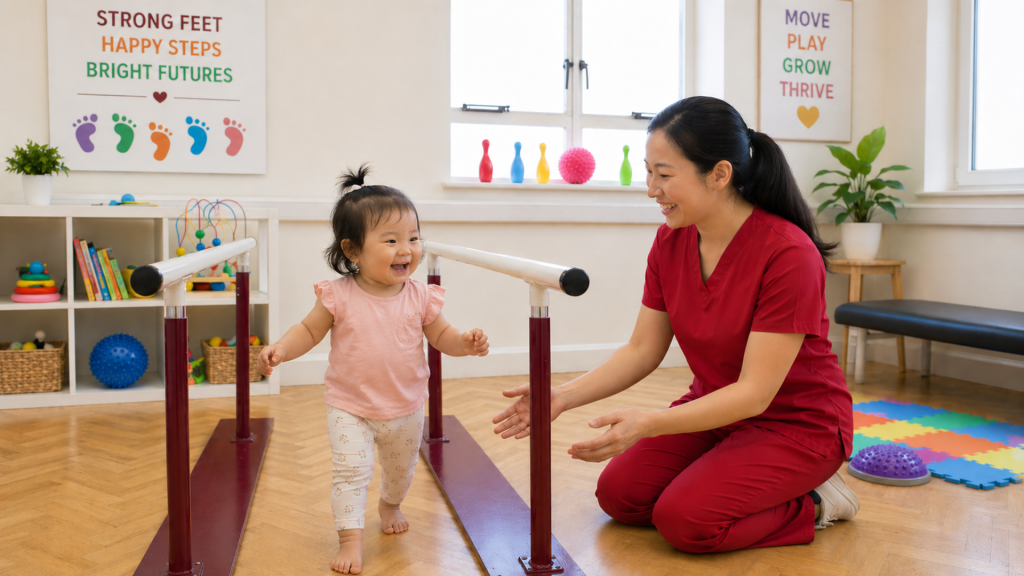
Paediatric gait assessment for late walkers is a structured clinical evaluation used to understand why a toddler (typically aged 12–18 months) is not yet walking independently or is walking with an unusual pattern.
It assesses:
The goal is to determine whether the delay is within normal variation or requires support from a paediatric podiatrist or physiotherapist.
A paediatric gait assessment helps identify the root cause of delayed walking and provides a clear, structured plan to support your child’s development.
For many parents, the biggest benefit is simply knowing what to do next.

Most parents are surprised at how simple and interactive the assessment is at Physio & Sole Clinic.
Rather than putting your child through tests, we observe how they naturally move:
We will also take a closer look at:
From there, we explain what’s happening and guide you on the next steps – whether that’s simple exercises, footwear tweaks, or just monitoring progress.
The goal is to give you clarity and confidence in what your child needs next.
At Physio and Sole Clinic, your child’s gait assessment is supported by both a paediatric physiotherapist and a podiatrist.
While our physiotherapists focus on how your child moves, such as strength, balance, and coordination, our podiatrists assess how the feet and lower limbs are aligned and support that movement.
This combined approach ensures that your child’s walking is not looked at in isolation, but as part of a bigger picture.
For your child, this means:
By bringing both perspectives together early, we are better able to guide your child towards stable and confident walking without overlooking important factors along the way.
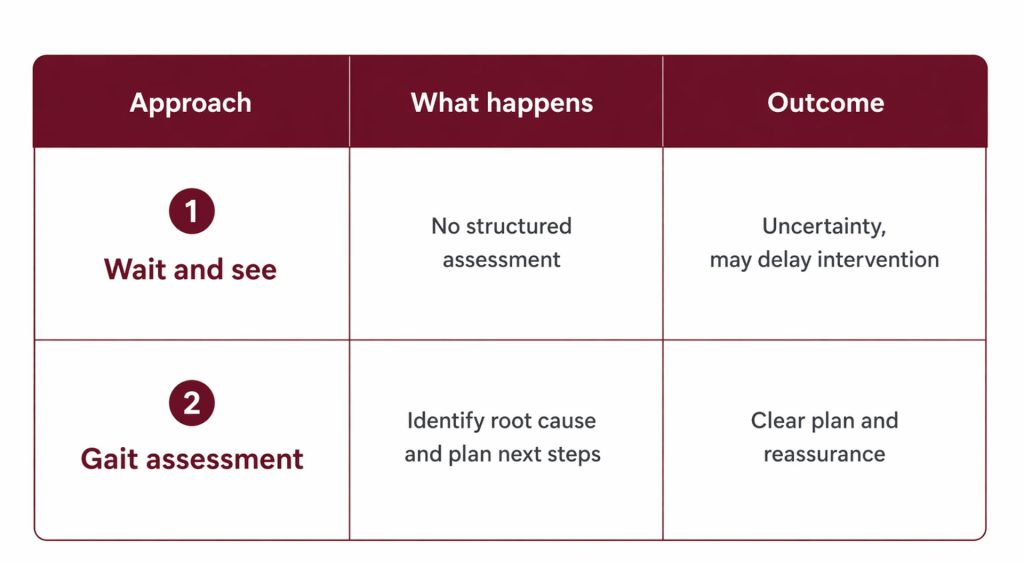
Without a structured assessment, it can be difficult to understand what is causing the delay in your child’s walking or whether your child needs support.
A paediatric gait assessment helps identify the root cause and provides a clear plan forward, giving you both clarity and reassurance on what to do next.

If your toddler is approaching 18 months, walking very late, or showing an unusual walking pattern, getting a professional assessment can give you peace of mind.
At Physio & Sole Clinic, our team combines physiotherapy and podiatry expertise to assess movement, foot alignment, and development, helping your child take confident steps forward.
Understanding the cause early allows for the right support at the right time.
This article is part of Physio & Sole Clinic’s Podiatry & Rehabilitation Resource Series, created to help patients better understand their treatment options and make informed decisions about their recovery journey.
You may also find these related resources helpful:
Phone: 9126 8257
Fax: 6281 1209
Email: contact@physioandsole.com
Whatsapp a Podiatrist: 87706213